





Welcome to the Escape Velocity Collection!
We are an opinionated group of friends reviewing all sorts of fantasy and science fiction media. Don’t forget to get to know the curators and visit our curated Collection, where we discuss the stories that never cease to transport us to another world.
Will you escape with us?
LATEST POSTS:
January 30, 2022
Collected on: January 30, 2022
- Dungeons and Dragons webseries by Dimension 20 for Dropout TV
- Released in 2018
- Starring Brennan Lee Mulligan, Emily Axford, Zac Oyama, Siobhan Thompson, Lou Wilson, Ally Beardsley, Brian Murphy
In this D&D web series, we follow a group of kids during their first year at Agueforth Adventuring Academy, a high school where kids learn to be classic D&D adventurers.
Fig has recently found out her elf father is not her real father, and she’s going through a rebellious phase. Gorgug is a gentle half-orc barbarian whose adoptive parents are gnomes. Adaine comes from a wealthy elven family, and is only going to Agueforth because she had a panic attack during her entrance exam for a fancy school. Fabian is the typical high school jock, the son of a ruthless but loving pirate father and a day-drinking elven mother. Kristen comes to realise that perhaps the god she has worshipped day and night for all her life isn’t quite all he seemed. And Riz is a wanna-be detective, desperately trying to solve the disappearance of his baby-sitter.
Peter: Welcome to this in-depth, spoiler-free discussion of the online video series Fantasy High by Dimension 20, which our curator Lotte has added to the Escape Velocity Collection, a series of items that we believe represent the absolute peak of what the speculative genre has to offer.
I challenged Lotte to defend her addition to the Collection – but also to explain what this emerging genre of filming yourself while playing a tabletop role playing game is all about.
Introduction
So generally, I would start off by asking questions on when and why you enjoyed Fantasy High, but in this case I feel we need to take a step back and talk to our readers a bit about what Fantasy High actually is.
I am assuming you are all familiar with the concept of tabletop role playing games like Dungeons & Dragons, Pathfinder, Call of Cthulhu, etc: games that are a weird amalgamation of rules, storytelling, and improv theatre, often complex, that tend to take the better part of an afternoon for a single session in a campaign that might span years.
Over the past years, a genre has emerged where people film themselves playing these kinds of games. Most of that content is made by enthousiastic amateurs, but by now there is also a fair number of professional productions out there – including Fantasy High.
I’ve watched a non-neglible amount of these videos, but they never worked that well for me – though our other curators don’t all agree. Lotte, before we dive into Fantasy High, could you maybe elaborate a bit on your experience with the the type of content that we are discussing here to get some perspective?
So I started watching Critical Role a couple of years ago, on the recommendation of a friend. I started watching when they were at the early stages of their first campaign. Now I’m the kind of person who likes to have some kind of video playing in the background while I do other stuff, so I got through the episodes quite quickly. I enjoy the fact that I don’t always have to be paying complete attention. Sometimes my mind wanders, but if it seems like I missed something important, I can always rewind a bit to see what I missed.
So, the genre never really worked for me because many productions are (relatively) unfiltered, unedited gameplay. They tend to be relatively slow to get going, and while they can definitively have awesome moments, these are separated by long hours of chatter and gameplay that don’t hold my attention. Fantasy High, however is different – so let’s turn there. Lotte, how did you run into Fantasy High, and what made you fall in love with it?
I started watching Fantasy High on the recommendation of the same friend, actually. It was the very start of the pandemic, and she send me a video of Gorgug asking people if they are his dad. She also assured me that it was only 16 episodes of two hours tops. Let’s just say I had some time on my hands, so I watched it – binged it, actually – in the next couple of weeks.
Fantasy High, isn’t like most other D&D shows out there. I’ll be honest: I haven’t seen many other streams other than Critical Role and Dimension 20 (who made Fantasy High). Still, Compared to the massive time sink of Critical Role, Fantasy High felt very manageable. It’s also mostly focused on comedy, and the episodes are edited. This show – while probably incredibly fun to play for the creators – is made for the viewers.
What Makes Fantasy High Different
As I said above, the genre never clicked for me and I assumed it was just because I didn’t like to watch other people play. So when you recommended Fantasy High, I expected to only watch it for the purpose of writing this post. What blew my mind though, is how different – how much more watchable – this type of content becomes when the people that make it, are actively editing and designing it to improve viewer experience.
You’re definitely right in saying that the concept of Fantasy High was created with the viewer experience in mind. I think this is where it really differs from something like Critical Role. And I’m not saying there’s anything wrong with Critical Role! I love the show, there’s just too much for me to keep up with at this point. The difference is that the cast of CR chose to continue their home campaign, thus starting their web series as a very traditional D&D game. There’s no editing apart from the opening titles, and episodes can range from 3 to 5 hours. This is what people liked, and so they’re still doing their main campaigns this way. None of this is criticism; it really works for them and they tell some amazing stories. It does mean that it’s very hard to get into for a casual viewer, or even for someone who wants to start watching halfway through a 500-hour campaign.
Dimension 20 makes shorter campaigns, Fantasy High itself totalling at most 32 hours. Because of the editing, we don’t see the players talking about rules too much. The world building is based mostly on concepts the viewer is likely already familiar with, so there isn’t a lot of exposition that, when missed, leaves you confused about the setting.
The Setting and Style
Good point about the world building: Fantasy High is set at a high school for fantasy adventurers – think a wizard as the principle and enrolling in ‘barbarian classes’. At the same time, it’s overflowing with Grease/The Breakfast Club type Hollywood high school movies clichés – the jocks, the nerds, the popular girls, etc. It may seem like a weird mix – and it is – so why did it work so well for you?
Now I love me a weird mix. I’m not a huge fan of high school media, but I’ve seen a lot of it. Some genre’s you just can’t avoid. I do, however, love Fantasy, and I’ve seen a lot of it. That’s why it’s so fun to see something like Fantasy High doing something with the genre that I haven’t seen before. Look, I love High Fantasy, but seeing something taking the classic Fantasy tropes and turning them on their head? There’s nothing better.
Surprisingly, I also enjoyed the humour. Comedy (especially American comedy) tends not to work for me at all. However, I play tabletop RPGs, I have consumed more fantasy media than I can remember, and I have even seen a couple of high school movies. I tick all the right boxes for the parody to work. I’m not saying none of the moments are independently funny – but don’t you think that for the setting of Fantasy High to work, you should probably have some experience playing a tabletop RPG and be familiar with fantasy tropes and clichés?
I do think you need to be familiar with some of the tropes, but definitely not with everything. I feel like most people have seen The Lord of the Rings and The Hobbit. That should be enough to get you to understand the majority of the Fantasy tropes used. And like you say, even you have seen some high school movies!
I do agree that people who have played some tabletop RPG’s will probably enjoy it the most, but I definitely think it’s comparable to the books of Terry Pratchett in this respect: if you know the tropes, you’ll love it. However, if you don’t know anything about fantasy, it will still be really funny.
The Game
Another important element to discuss is the game itself. Even if Fantasy High is different in that it is sleekly edited and a lot shorter, this is still a series about people playing D&D – and it therefore has some of the same pitfalls.
You just said that you didn’t feel that experience with tabletop roleplaying games is necessary to get the story – but does that also apply to the rules? If you’ve never played a game like this, would you understand what happens when someone says ‘roll for initiative’ and everyone groans, or ‘natural twenty!’ and everyone cheers? Do you even know what a hit point or a D8 is? Isn’t half of what is going on just mumbo-jumbo?
I think it probably can be confusing at first, but I find that in Fantasy High, even the rules aren’t the most important thing about combat. The players describe their actions, so while you may not understand exactly why an action did not work, it won’t detract too much from the experience, because it’s not the why that matters – it’s what actually happens. There’s actually plenty of people who got into D&D from watching streams like Fantasy High and Critical Role.
I suppose it’s similar to how I’ve recently started watching figure skating: At first I didn’t know the skaters, and I didn’t know the rules. Now I know much more about individual skaters, but I’d still be unable to tell two jumps apart. Still, I enjoy it more, because knowing the “characters” means that I know what the stakes are for them. And at the end of the day a high number is good, a low number is bad, and when someone falls flat on their face even I know that’s not great. There’s a lot you can tell from people’s reactions to the result of a dice roll that will ensure that you don’t even need to know the specific rules.
Also, there’s a fair amount of the cast who are first time D&D players in Fantasy High! So you wouldn’t be alone in being unfamiliar with the rules.
In this show, combat is never just combat. There’s no combat for the sake of combat, it always serves a point in the story. I’ll be honest: I’m not a huge fan of combat myself. Sometimes I feel like I’d prefer to just skip it. However, in Fantasy High, it’s not just rounds and rounds of swinging swords and slinging spells back and forth. Instead of it being an hour of roleplay followed by an hour of combat, there is roleplay in the combat as well. Every scene in Fantasy High serves a purpose, which is absolutely wild if you consider that it’s basically all improv.
I should also mention that there’s some lovely set design in the show. Because it’s not a typical high-fantasy setting, I imagine it’s a lot harder to source/create set pieces for the battles. They’re always stunning, though.
Oh yes! Brennan is an amazing DM! I think tastes probably vary in terms of what people look for in a DM, but Brennan, for me, just does a lot of things really well. He’s incredibly knowledgeable about the rules, but he’s very willing to let players try (and succeed at) cool things. He’s funny but also able to handle emotional situations really well (sometimes at the same time). He’s also just amazing at improv. Like, he’s the DM so it’s clear he probably prepares a lot for the show, but nothing fazes this guy – and the players absolutely do try sometimes!
Conclusion
So we can conclude that Fantasy High is a D&D-game stream which is much more accessible than other versions of the same content – shorter, better edited, focussed on fun moments and improv comedy, with a cool cast and a great DM. I would recommend Fantasy High to anyone who has been on the fence about this kind of content – give it a shot, you might be surprised how much you like the experience. Is there anything you would like to add or specific people you think should give Fantasy High a shot?
I would recommend Fantasy High to people who like their fantasy a little bit light-hearted.
And as Peter said, if you’ve been interested in D&D and feel intimidated by a show like Critical Role, then Fantasy High is the perfect way of dipping your toes in the genre to see if it’s your kind of thing.
I’d also recommend the show to people who really like the books of Terry Pratchett and people who loved the show Galavant for it’s delightful mix of classic fantasy and modern concepts.
Hi guys, and welcome to the first update post of the new year!
Each month, one of our curators looks back at what they’ve been up to over the past weeks and what we can (hopefully) expect from them in the not-too-distant future.
This month, Lotte will take you through her experiences in the speculative genre over the past month. Curious what she’s been reading, watching and playing?
Read on!
Past month
This past month, my favourite post has to be the Journey of a Sci Fi noob. I do relate to Jop in this, as I myself tend to prefer Fantasy over Sci-Fi. It can be hard to find content that you’ll enjoy in a genre you’re unfamiliar with. I will say, though, that reading that Jop thought Mass Effect was “just fine” fully crushed my little heart.
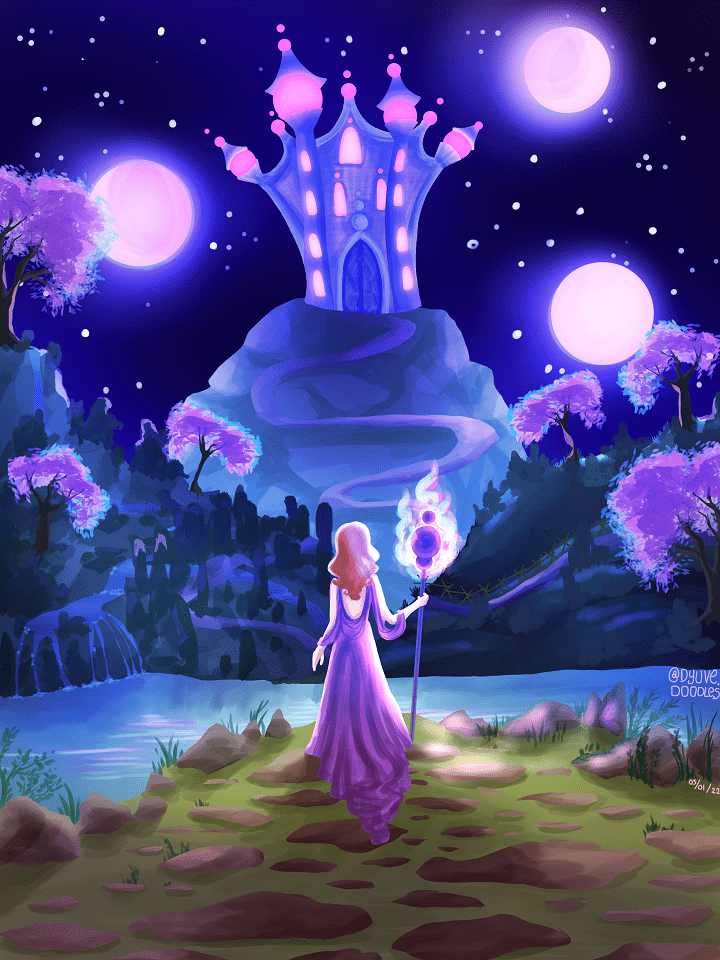
Since a friend fixed my gaming PC a month or so ago, I’ve finally been able to spend some time drawing on my PC instead of my iPad. It’s been tricky getting used to my old drawing tablet again! It’s a tablet without a screen, something I used to be very comfortable with but feels very unfamiliar to me after almost two years of drawing on a screen. I really want to draw some fantasy environments and characters! I’m definitely trying to focus on quality over quantity this year, though, so I don’t expect to be churning out art twice a week like I did last year. still, if you’d like to follow along on my art journey, feel free to follow my art Instagram here!
Upcoming
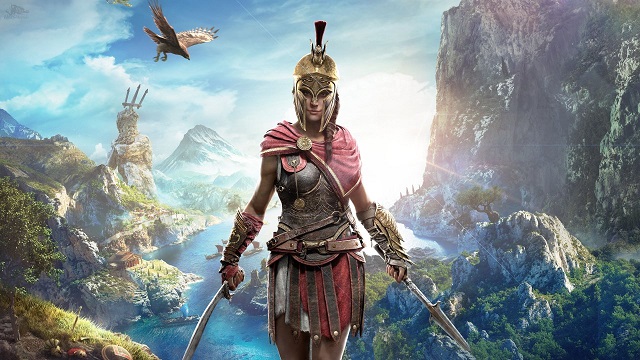
Another advantage to having my gaming PC up and running again, is the fact that I can finally go back to the game I’ve been playing for… maybe a couple of years now? The game in question, Assassin’s Creed: Odyssey, is fully worth it, though. I’m about 100 hours in and while I know I should probably focus on finishing the main quest, I’m really enjoying exploring ancient Greece. I’ll review it when I finish it! If I ever do…
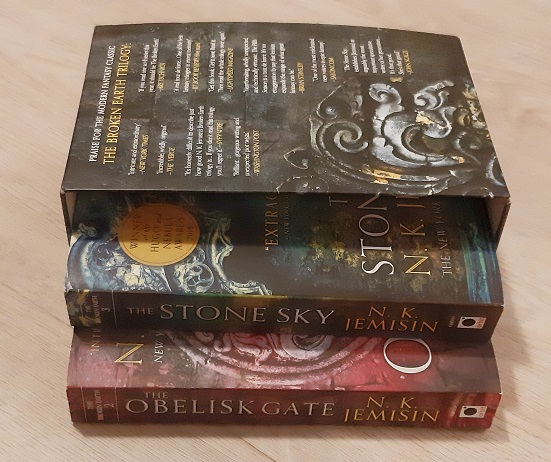
I also recently finished the Broken Earth Trilogy, by N. K. Jemisin. I really enjoyed the series, and immediately harassed Jop and Robin into reading them, too.
You’ll notice that the first book is missing from my collection. It’s currently with Jop!
Finally, fans of Dimension 20 will know that this month marked the release of Dropout’s new D&D show, a Starstruck Odyssey, which features the original Dimension 20 cast on a Sci-Fi adventure.
So far they’ve released three episodes, and it’s definitely a wild ride! You can expect a review when the season’s complete.
- Audio drama written by Jeffrey Cranor & Janina Matthewson
- Produced by Night Vale Presents
- Released in 2016-present
- Starring Janina Matthewson, Rima Te Wiata, Lee LeBreton, Mona Grenne, Norma Butikofer, Amiera Darwish and Leah Minto
Every season of Within the Wires tells a stand-alone story within an alternate history of the 20th century. The Great War has spun out of control and raged for decennia, reducing the whole world to rubble. After this, the survivors build a New Society while rooting out the cause of all conflict: tribalism. How? By dissembling the nuclear family…
I love this audio drama! Each season tells a beautiful, personal story that is worth the listen on its own. But one of the reasons I really like this audio drama, is the way it is structured: every season uses a new kind of found audio. And this medium is not just a way to justify the way the story is told, it is in the core of the kind of story that is told. In addition, every season shows a completely different side of the world in which the stories are set. The stories come first, but there is a real marvel in piecing together the world behind them.
Every season is very different, so a sort review per season:
- Relaxation tapes, unknown date. Not the easiest to start off. It takes some time before you find the story behind the relaxation tapes and the tapes transition into more storytelling. But when it does, it is a heart-wrenching story. And the institute where it takes place is at the core of the alternate world you’re piecing together.
- Audio guides, 1971-1986. I think my favourite season. It has the most innovative way of storytelling and its story is hardest to grasp. It was wonderful to be invited to imagine all the different art pieces the audio tour touches upon. In the reflecting power of art, you see the changes of the world that the artist lives in.
- Office reels, i.e. notes to a secretary, 1953-1961. This season has a great tension build-up with something of a detective-feel to it. You feel something is off, but who is exactly playing who? Also a great sneakpeak in the bureaucracy of the New Society. A way more positive image than we have seen so far.
- Audio messages, 1993-1999. These are letters from a mother to her daughter, leading a community living in hiding from the New Society, because they chose to live with family. It shows another side of the multi-sided coin that is this world. While the mother is travelling around the world spreading the idea of her Cradle, her community grows more distant under her daughter’s leadership. Although it was interesting in the aspect of world building, this was my least favourite season. The story and acting could not hold my attention.
- Phone calls, 2008-1997. A love story in reverse, literally. It took me a while to figure this one out, but when I felt it, oh, I felt it. Sprinkled with worldbuilding on the surveyance-side of the New Society, it was another great season.
- Medical notes of an in-house nurse, 22-30 October 1973. A ghost story. Not the best season as far as the use of the type of audio is concerned and the paranormal felt a bit out of place in the world built by the previous seasons, but the end kind of made that make sense. Anyway, it was a truly and beautifully haunting story that brought the mysterious ‘Great Reckoning’ closer.
You don’t have to listen to them in order, but you do have to listen to them! So take your pick!
Tagged:
In an alternate history of the 20th century, the Great War – or, in this world, the Great Reckoning – has spun out of control and raged for decennia, reducing the whole planet to rubble. In these circumstances Miriam developed a kind of meditation that could separate people from their trauma’s: the Watercolor Quiet. In her memoires she writes how she grew up during , discovered the Watercolor Quiet, and developed it in the New Society establishing itself when the smoke cleared. The Watercolor Quiet became instrumental for the new regime as a way to separate people from their unwanted memories. Although those memories were not always trauma’s.
This book was my most anticipated work of fiction of 2021. It is set in the universe of Within the Wires, an alternate history audio drama and one of my absolute favourites. One of the reasons I love this audio drama is the way it is structured (see my review there), and the book presents itself in the same tradition. Instead of found audio, this story is found written work: a memoir. But there is more. It is a memoir presented by a journalistic organisation who claims to have scrutinised the facts of the memoir and found them full of unfounded allegations. Yet, the organisation holds free speech above all. Therefore, it circumvented censure by the New Society government and found you, the reader, to be responsible enough to read it. ‘Whatever you do, don’t distribute it further.’ Whether this is a sincere warning or actually an invitation is unclear. Does the journalistic organisation really believe the memoir is full of fake facts or does it say so to appease the New Society? It is left for the reader to decide.
It was a good book. It has a very easy to read style, poetic at times, and the life described in the memoir was interesting. But above all, it was amazing to dive deeper in the world I had come to know through the audio drama. And this bothered me. I want(ed) to like the book for its own merits. And I did, but not as much as I would have hoped.
For example, I did not really like the narrator, mostly because of the tone of voice. There is quite some stream-of-consciousness passages where her mind wanders, notices something and then cuts herself off. ‘Irrelevant’, she says, over and over again. Well, let me be the judge of that! It might be purposefully ironic that the founder of a trauma-separating therapy is pushing away her memories, but I found it pretty annoying. I also disliked the stalling in the story, at times it felt a bit cheap and out of place. I mean, there were in no way Dan Brown-stretched tension spans, but still.
I really wanted to love this book and be fully immersed. I hate that two quite minor stylistic things bugged me so much. They kept me from going deeper with this character. However, I should not place too much emphasis on this. I really enjoyed the book. Maybe more for the world building than I would have liked, but still, I give it a well-deserved 4 stars.
Tagged:
Jop: It’s me. The noob in the title, that is. I’m ashamed to admit I’ve horribly neglected the science fiction genre in the first three decades of my life. In fact, I could count the science fiction books I’ve read on only one hand. Yeah, I’ve got little excuses…
Though, mayhaps this was a blessing. Why? Well, now I’ve got this whole new genre to explore. I’m somewhat of a tabula rasa, a fresh pair of eyes. Through my journey of exploration, others get the chance to relive and reevaluate their own science fiction experiences! Why did they fall in love with this genre? Do they recognise themselves in my growth and/or growing pains? And if they are science fiction noobs like me, which paths should they tread to successfully evolve?
Today, I’ll reflect on my first experiences with science fiction so far. Luckily, I’m accompanied by Peter, who’ll be something of a mentor character to me on this journey. Together we’ll take a look at science fiction’s wide range of stories, and see if I’m on the right track or in desperate need of some guidance. Let’s begin!
Check out our other posts on content mentioned here:
Let's start somewhere simple: what is Science Fiction?
Perhaps I’m approaching it too scientifically (pun not intended), but first I’d like to establish a clear understanding of what science fiction is as a genre. I know, this is tricky business. The boundaries of genres are by nature quite elusive. However, it’s something I occasionally still wonder myself.
Like I already said, you’re the veteran here, Peter. I’ll shamelessly pass the difficult questions on to you. Could you share a brief explanation of what you believe is the essence of science fiction?
Straight to the essence, then? I believe that at its core, science fiction is the speculative genre that deals with the consequences of (hypothetical) future events for our society. Stereotypically, those future events are advances in science and technology, but other subgenres, such as alien invasion stories or cli-fi, deal with different types of futures.
I think it is worthwhile to pause here and note that that definition differs from what society at large tends to label as science fiction. People less invested in these kinds of debates treat science fiction more as a setting or a visual style and less as a genre: any media that include elements of advanced technology or space travel are in their eyes science fiction. The textbook example is George Lucas’ Star Wars, which features spaceships and laser guns, but really never delves into the meaning of space travel for the society that it portrays. There’s also magic. Is that science fiction? Most people would probably say yes, but it doesn’t fall within the scope of my definition above.
I will stay away from unnecessary pedantry. I’m not saying these people are wrong. But I think the above distinction is important to understanding, as you requested, the ‘essence’ of science fiction. There is a lot of media out there that is branded ‘science fiction’, that is really very much akin to fantasy in a high-tech costume. And in that case, whether you prefer one or the other is mostly a matter of taste, since those stories offer similar rewards.1
I believe that the ‘ideal’ ‘true science fiction’, on the other hand, differs from fantasy stories in two important ways: first, it is grounded in our reality, and (mostly?) obeys all the same laws that our world does; and second, it is an honest attempt at exploring how our reality would change as a result of hypothetical future events. The essential exploration, therefore, tends to be one of society, not character.2 Science fiction is an inherently political genre in a way that fantasy just isn’t, and I think that is the essence that sets it apart.
Fair enough. We’ve discussed this a little before in the past, and I think it’s an interesting distinction. Without favoring one interpretation above the other, it clearly shows how diverse the science fiction genre can be.
I notice that your definition emphasizes the importance of (hypothetical) future events. To further clarify, does this mean that science fiction, if it’s a story in our world, can never take place in the past or present?
Well, I’m a lawyer so I can tell from practice that almost no definition is watertight. Stories set in the present can clearly be science fiction – they tend to extrapolate from the now into a possible future. Stories set in the past are slightly more complex – 1984 didn’t cease to be science fiction in 1985. And if your alien invasion story is set in 2001 rather than 2021, I wouldn’t necessarily say that makes it alternate history. If you write a story where Da Vinci invents a rocket to the moon, or a laser gun, however…
That means you sometimes run into interesting situations – is Jules Verne’s Twenty Thousand Leagues Under the Sea science fiction? Is it steampunk? Is all steampunk science fiction? I’ve seen people classify steampunk without sufficient science fiction elements ‘gaslamp fantasy’, I’ve seen others rule out every story with mystical elements as science fiction. At that point, I feel as though we’re categorising for the sake of categorising and not because the category helps our understanding of what we’re reading.
I think what is important to keep in mind, is that the speculative elements in science fiction should aim to, or should be able to, speculate about the impact of hypothetical future events on a society that is in important ways like our own.
Very well, with that good working definition in our pockets, I believe we can dive deeper into our respective science fiction journeys…
Looking back: The Journey so far
Peter, let’s prove why you’re a veteran and I am…not. When did you first come into contact with science fiction and what were some of the most formative media you’ve enjoyed since then? Afterwards, I’ll contrast your experiences with mine.
My parents are massive science fiction fans (devouring hundreds of pages every holiday since they were still in university), so the book (and movie) shelves in the family home have always been well stocked with sci-fi stories. I know I just made a case that Star Wars isn’t science fiction, but…my dad is a fan, and I was probably about six years old when I was first confronted with its visual style. I’ve been hooked on sci-fi since.
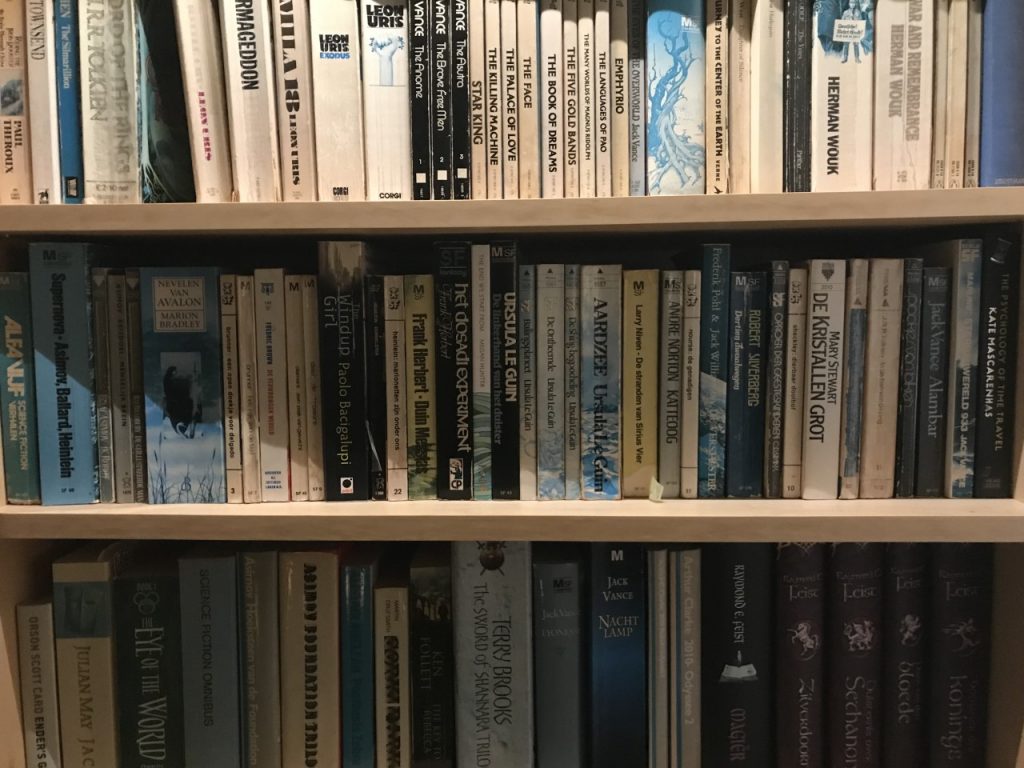
It’s a (relatively mediocre) shot of my parents’ “old-timey” sci-fi shelf (there’s some secret fantasy intruders, but ignore those) with mostly books from their uni years – can you imagine people used to read in translation back then?
Many of my early experiences with science fiction were with the classic stories from the second half of the last century that straddle the divide between fantasy and science fiction: Jack Vance, Julian May, A.E. Van Vogt – mostly because that was what was readily available on my parents’ shelves. I loved my lego Star Wars sets to bits, loved the lego alien space station the boy next door owned. I started drawing and imagining my own mechas (imaginatively dubbed ‘superrobots’) when I was maybe seven years old. I started playing Warhammer 40K when I was about ten. By then, I had fallen in love with science fiction as a setting.
When I grew a bit older (about high school age) I started reading more of the science fiction that I would describe as ‘true science fiction’. Looking back, that’s sometimes still pretty young to be reading about the societal problems caused by advancing technology, but back then I didn’t mind. I particularly loved (and still love) Asimov’s robot novels.
From there, there’s really too much to list. I’m sure many of our readers have read even more than I have, and there are tons of books and games and other media that I should really get to that are gathering dust on my various shelves of shame. There is just so much out there to explore! I feel relatively comfortable, however, saying that I have a lot of experience with science fiction stories – and if you will accept me as such, I would love to be your mentor throughout this tale.
You’ve convinced me! I can’t think of someone I’d rather have on this specific journey.
As for my experience… I believe that my first taste of science fiction also relates to Star Wars. When I was six or seven years old, I played the Phantom Menace video game at a friend’s place and later watched the movie. It didn’t make much of an impact, but I thought it was fine (unpopular opinion, but I remember thinking Jar Jar was funny). It then took something like ten years before I binged the other movies with my then brother-in-law. I can’t remember any other science fiction experiences in that ten-year gap, probably because I was busy with consuming as much fantasy as I could get my hands on.
That brother-in-law did his best though. He also introduced me to The Matrix trilogy, which I found intriguing. During high school’s philosophy lessons we watched several other science fiction classics, such as 1984, and movies such as A.I. by Steven Spielberg. I also watched a handful of mainstream science fiction movies (Inception) and a load of disaster movies (that were almost science fiction) and first contact movies, but most of these were primarily focused on the action scenes and not so much on any interesting (political) implications.
It was also around this time I started watching The Walking Dead, a franchise that technically fits the stated science fiction definition, I believe? Correct me if I’m wrong. If it counts, however, the themes and setting of the The Walking Dead-universe were the first time a science fiction medium truly grabbed me for a longer time period. Especially the Telltale Games. Since then I’ve discovered I quite like post-apocalyptic settings.
In more recent years I’ve watched series such as Sense8 (which I truly loved), Black Mirror and The 100. My Bioware sister, Lotte, urged me to play the Mass Effect games, which I of course did. And you introduced me to Dune, the first real science fiction book I’ve ever read. Another science fiction constant in my life would be the tabletop roleplaying campaign (Seed of Mars) you’ve been running over the last few years. That’s about it, actually.
What do you think?
Well, you’re certainly no veteran but compared to the general populace, I don’t think you’re doing that poorly.
Interestingly, it looks as if you have almost never picked up a science fiction story because you wanted to yourself, but always because others recommended (not to say: pushed) you to give them a go. So… do you even really want to delve into science fiction? Or is it peer pressure again? Do you need a safe word?
You know what, that’s actually a rather fair observation you make? Wow…
However, my current wish to delve deeper into the world of science fiction is entirely intrinsically motivated (as far as I can determine, in any case… but that’s good enough for me!).
Bring it on!
Looking inward: Where has the Journey brought us until now?
I’m glad you really want to take this dive! Before we pick our first stepping stones, let’s take one final look at your experience with science fiction so far. We have quantified our experience – I have a lot of experience, and you have less – but we haven’t qualified it. You’ve experienced a few sci-fi tales – how has it been for you so far?
Good question. Overall my feelings are quite ambivalent, actually. There were some things I really liked – mostly the stories that were centered around a specific interesting concept, as they do in Black Mirror – but on the whole I’ve yet to find something that rocks me to my core. Something that will haunt me for years and convinces me that the science fiction genre deserves more time/love than that I currently give it. Perhaps I’m asking too much, but I’m aware I’ve only dipped my toe in the vast ocean of science fiction media. There must be something somewhere that will sweep me off my feet, I’m sure of it. Something that touches my heart as well as challenges my brain.
We all know that you have experienced a tonne of fantasy stories, and that many of them did, in fact, rock you to your core. I argued above that a lot of science fiction is really fantasy in a high-tech costume. Could you put your finger on why stories set in space haven’t resonated with you in the same way that those set in an alternate medieval Europe have?
Robin tends to say she rather reads a story that takes place in a forest than a story that is set on a spaceship. Why? Because she enjoys mystical atmospheres and a focus on natural elements, as is predominant in fantasy.
Robin’s explanation might seem a little reductive, but it resonates with me. I don’t really like technology. Don’t take this wrong, I’m not a technophobe or anything. It has brought humanity a lot of good things, and I think it can offer extremely interesting questions and plot points for science fiction stories. However, in and of itself I don’t find technology very… romantic. I think it reminds me too much of our current world. This would also explain why I have a soft spot for post-apocalyptic settings; the technology in these worlds is often strongly diminished, if not completely faded away. As this usually comes with nature reclaiming earth, the aesthetics become more like that of fantasy.
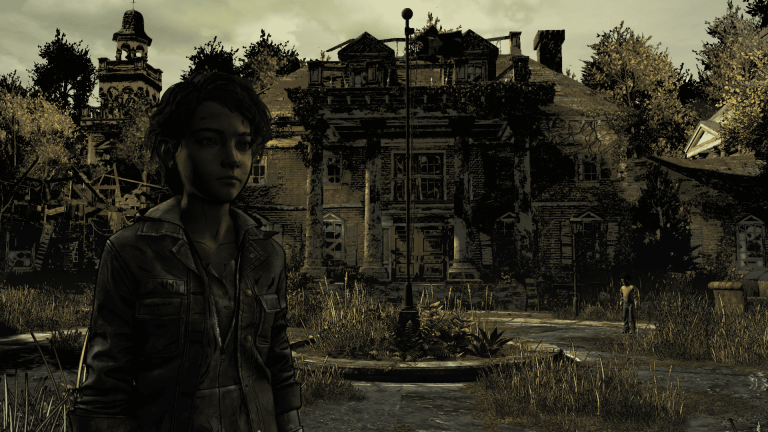
Just look at this beautifully desolate setting, a future in which zombies toppled human society. Structures are crumbling and nature is taking over. Bonus points when a new layer of ‘civilization’ is built upon the ruins of the former.
However, I believe there’s more to it, though I find it hard to put it into words. For example, why do I love Dragon Age, but thought Mass Effect was…just fine, while they are in many ways very similar games?
It might have something to do with science fiction’s pursuit to at least appear scientifically plausible, even if it’s almost fantasy in most other aspects. This comes at the expense of mystery and wonder for me. For example, I prefer my magic systems soft or medium rare. I don’t wish to know all the rules, as long as they are vaguely implied. With science, however, I’m inclined to chase after the rules with the intent to really understand them. Then, there are roughly two outcomes; 1) everything is logically sound and therefore, I lose a sense of mystery, or 2) there are some grating holes in the ‘science’, which lessens my enjoyment of the story.
I’ll admit though, I still have some soul searching to do before I can satisfactorily answer this question.
So let’s embark – or maybe I should say – continue our way – on that journey!
Looking forward - Whereto?
If this is indeed a hero’s journey, I have only just yet passed the threshold. I still have much to learn.
Peter, I’m your Padawan; guide me. What media should I – and all those who wish to join me on this path of enlightenment – consume for the next leg of this journey?
That’s a tough question because there is an overwhelming abundance of choice. But I think we should try to limit our selection to media closer to the ideal of ‘true science fiction’.
Sounds good to me! As these are to be my first real steps, perhaps something from the earliest days of science fiction to start with? Some classics that helped define the genre, so I can see where it all began?
I think that would be a good place to start! I know some of you readers are already (mentally) shouting names at your screen – but we have to pick so we’ll have to disappoint some of you. I’ve decided not to ‘take it easy’, but rather to go for some of the most iconic authors of the genre and some hard sci-fi.
I’m glad you already read Dune, that’s one classic already ticked off. In the end, I’m going to go with a number of works by three authors: I, Robot by Isaac Asimov, because Asimov is synonymous with classic sci-fi and I love it myself; Do Androids Dream of Electric Sheep, The Minority Report, and I Hope I Shall Arrive Soon by Philip K. Dick, because I think Dick’s writing offers an interesting mix of different classic ideas and settings, and finally Consider Phlebas by Iain M. Banks – a little different from the golden age stuff, a little more modern, but still a classic – and I think the Culture is a fascinating setting to explore in getting to know sci-fi.
Let me know once you’ve finished them, and we’ll see what you think. In the meantime – enjoy!
So, are any of you fantasy fanatics with no sci-fi experience? Or maybe sci-fi aficionados who never picked up The Lord of the Rings? Let us know on our social media!
1. Yes, ‘sci-fi setting’ stories may contain elements of ‘true sci-fi’ that fantasy stories will not, but I’m trying to make a point here, and too much nuance would kill it dead, and also make this conversation twenty pages long.
2. Jop and I have discussed this position at length, and maybe one day we’ll write you a little something delving into this as well!Jop and I have discussed this position at length, and maybe one day we’ll write you a little something delving into this as well!
- Video Game developed by Telltale Games & Skybound Games
- Released in 2018
- Singleplayer narrative adventure game
- Platforms: Microsoft Windows, PlayStation 4, Nintendo Switch, Xbox One
- Playing time: 8-19 hours
- Fourth and final season in Telltale’s The Walking Dead series
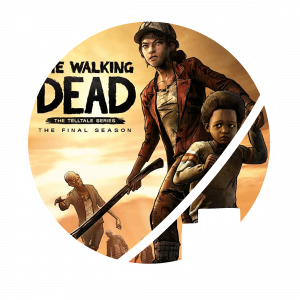
Clementine is finally reunited with AJ, the boy she has sworn to take care of. However, raising a child in a zombie apocalypse comes with many challenges. Where will she find enough food to keep them both healthy and strong? And will she teach him solely to survive, or also to live?

Ah, yes. Another one of my all-time weaknesses. My video game daughter, Clementine…
Those who are familiar with the Telltale Games’ The Walking Dead games will understand what a journey it has been, watching Clem evolve from an innocent 8/9 year old into a strong, independent survivor in her mid-teens. A journey that almost ended prematurely when Telltale Games went bankrupt at the moment the Final Season was only halfway done. Luckily, we still got the closure we deserved.
It’s funny. I like The Final Season the most out of the whole series. Though this game is not entirely without flaws, its story and themes are more cohesive than previous installments. The setting – a boarding school inhabited by children and teenagers – is a perfect fit for Clementine as a main character. For the first time Clementine is amongst equals, and thus in a situation that it makes sense that others look to her to make difficult choices that guide the story. Additionally, I really liked the cast of characters (including the antagonist), as all of them play into Clem’s inner battles one way or another. This is especially true for her relationship with AJ, the two potential love interests, and the main antagonist.
On the other hand, much of what makes The Final Season great, is that it can build on the fundaments of its predecessors. The parallels and backstory strengthen the narrative. Though this game is quite solid on its own, I think it loses a large part of its (emotional) depth when one should play it as a stand-alone.
There is much to love in this game. The voice-acting, art and design, among other things. Still, I’m most fond of the difficult choices this game throws at you. Raising AJ, carefully balancing morals with surviving instincts, was one of the most challenging though pleasing elements for me. Furthermore, I’ll always fondly remember the thrilling suspense of the third episode, even though my heart will never quite recover from the stress.
In conclusion, a beautiful ending to the story of one of the most iconic characters in gaming history. Love you, Clem <3
See also:
Tagged:
- Adventure, Atmospheric, Character-Driven, Found Family, Grimdark, Horror, LGBTQ+, Microsoft Windows, Nintendo Switch, Parent-Child, Playstation 4, Point-and-Click, Post-Apocalyptic, Science Fiction, Sequel, Single-player, Stand Alone, Thought-Provoking, Video Game, Violence & Gore, Xbox One, Zombies

Collected: Fantasy High by Dimension 20
COLLECTION: It’s the first day of school at Agueforth Adventuring academy, a school for teen fantasy hero’s. Will our intrepid adventurers make it through the year?


Review: Within the Wires – Night Vale Presents
Every season of Within the Wires tells a stand-alone story within an alternate history of the 20th century where the nuclear family is no more.

Review: You feel it just below the ribs – Jeffrey Cranor & Janina Matthewson
Review of You feel it just below the ribs. A book in the same universe as audio drama podcast Within the Wires.
Curator Conversation: The Journey of a Sci-Fi Noob (Part 1)
In this series, we will introduce on of our curators to a whole new genre – science fiction! Will sci-fi prove as addictive to Jop as fantasy has always been? Read the first part to find out!

Review: The Walking Dead: The Final Season – Telltale Games
Review of the video game The Walking Dead: The Final Season by Telltale Games.
Clementine is finally reunited with AJ, the boy she has sworn to take care of. However, raising a child in a zombie apocalypse comes with many challenges. Where will she find enough food to keep them both healthy and strong? And will she teach him solely to survive, or also to live?