






One would think that if there is one genre of video game that is well past its prime, it is the point-and-click adventure. Until a couple of years ago, I would’ve guessed that nobody would still be making them. I now know that that’s not true – and that great point-and-click games are still being created today.
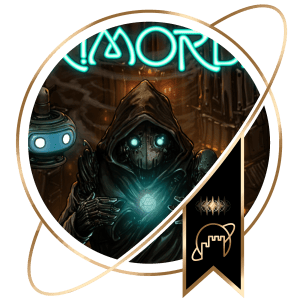
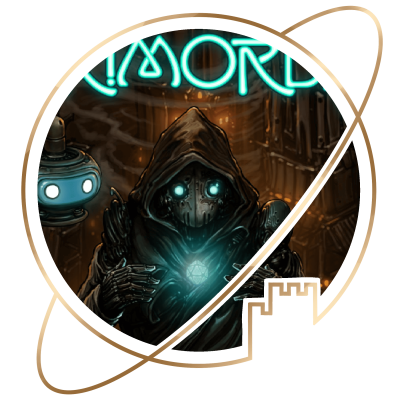
One example is Primordia. It is 100% a classic point-and-click game. The gameplay is as you’d expect: your character travels a post-apocalyptic landscape consisting of detailed single screen environments, and interacts with the world by clicking on the objects and characters he encounters there. You progress through the game via a set of simple logic puzzles that require you to find things, fix things, bring characters certain objects, and answer questions. Most of the puzzles are easy enough to solve, but some are a bit trickier. Like any point-and-click game, you’ll find yourself endlessly clicking elements of the world to see if they come loose, and whenever you add a new object to your inventory, you’ll want to go back to earlier screens to see if it can be useful there. Like any point-and-click game, there are moments where the gameplay devolves into a rather cynical ‘rub x on y’, to see if anything happens. Luckily, the game allows you to ask Crispin for hints, and none of the puzzles seemed unfair in hindsight – though trying to speed through it in one sitting is bound to become frustrating. Every now and then, a eureka moment is required – I initially played with a friend, and I remember calling him while cycling home to ask if he could try looking in that one spot because I thought we might have missed that… and bingo! I love the game for those moments: it offers simple, laid back, but quality gameplay that can also be fun to share.
The game’s primary appeal, however, is its aesthetic. The world is built up out of beautifully drawn environments and great pixel art characters and objects. Primordia has a great atmospheric soundtrack, sucking you into the world. I find myself still listening to it from time to time when I want something relaxing on in the background. The voice acting is also great, especially the little conversations between Horatio and Crispin. Little elements like those forge a surprisingly deep bond between the player and the characters for how simple the game is.
The point-and-click experience is not for everyone. However, this style of game is also especially well-suited to people that don’t like the flashy speed of modern gaming, people that don’t consider themselves ‘gamers’, but might be interested in a stress-free interactive puzzling experience with great characters and art. My parents, for example, loved playing Primordia together.
Overall, Primordia is near the top of my list of favourite games, which I think is a wonderful achievement for such a simple game that can be picked up for less than ten euros.
To give you one tip for your playthrough: when in doubt – plasma torch.

Peter just couldn’t stop pestering me about this game, recommending it at every opportunity he got. It was only a matter of time before I would succumb. And I’m grateful for his perseverance.
Primordia is a fairly simple point-and-click puzzle game, embellished with atmospheric music and pixel art. It transports us to a post-apocalyptic world in which humans have made way for their robot inventions. As a player, you control Horation Nullbuilt, an android scavenger living in a stranded airship with his own robot companion.
Horatio, having a gruff voice but (depending on your choices) soft-hearted demeanor, reminded me a lot of Geralt of Rivia. This made it easy for me to like him and get invested in his story and the world he lived in, which both have a lot more depth to them than at first appeared. At times grim and sad, but also full of light-hearted moments and silly humor. It’s impressive how – in both its storytelling and worldbuilding – Primordia is extremely efficient, only using the bare minimum to craft a fulfilling narrative. And if that’s not enough, there are also multiple endings available, dependent on choices you make throughout the game.
The puzzles in this game can be challenging at times, but if you let the wheels in your head turn long enough, it’s unlikely you’ll never beat them, one way or another. If I were to give a hint, it would be the heads-up that the map in your data pouch can be used for fast travelling. I only discovered this helpful mechanic quite late…
I won’t pester you to play this game, but honestly? You would deserve it.

I have to admit something about Baldur’s Gate: the classic 1998 6-CD-ROMs-in-one-box version of the game was one of my very first ventures into the high fantasy genre. I distinctly remember sitting on my father’s lap (I was literally that young) building a character. I designed a dwarven fighter. I remember spawning outside Winthrop’s Inn, just with a quarterstaff, and walking around Candlekeep. I made my father read and translate all the flavour text, and I remember him trying to convince me to sell the Lynx Eye Gem Phlydia gave me after returning her book, but refusing, because the flavour text said dwarves liked gems (“but it said they like gold too!”). The game, its world, the possibilities, they completely blew me away – and I never even left Candlekeep. It took me a fair few years before I was old enough to actually play the game, but I think it would be fair to say that with the memories I have of this game, I cannot be entirely objective.
Baldur’s Gate is a top down roleplaying game, with relatively simple isometric graphics and limited voice acting, consisting of a great number of separate map areas (ranging from towns to dungeons to mountain fortresses and rocky coasts) that can each be explored with a party of the player character and up to five companions. Movement and combat appear to take place in real time, but (astonishingly) follow the turn-based rules of the tabletop RPG Dungeons & Dragons, down to weapon damage being indicated in dice (for example, 1D6+2, or 2D4, referencing 6- or 4-sided dice). Interactions with NPC take place through text menus with (often extensive) dialogue options. The setting is a relatively standard medieval high-fantasy setting, taken from the Forgotten Realms campaigns produced by Wizards of the Coast themselves.
Baldur’s Gate is a bizarre game. The D&D rules system, though allowing for a breadth of possibilities, is positively arcane for people not already familiar with it. The interface is manageable but far from streamlined. The graphics are simple. The combat can be tense but has you looking at a freaking scroll of text displaying dice rolls in the bottom of your screen more than at the actual characters fighting. Trying to describe it, it seems almost unimaginable that anyone would want to play it.
Yet, if you do know (some) D&D, and want a video game experience with a cool story, mysteries to unravel, in-depth character creation and progression, and a more laid-back style closer to a strategy game in controls, Baldur’s Gate is perfect for you. It is a way to scratch your D&D itch if your session’s been canceled. A way to get a taste of what D&D can be like if you’ve yet to find a group. A roleplaying game that does not rely on actions per minute or reflexes for your character to be a hero. A bath of nostalgia for some people.
I realise Baldur’s Gate might not be for everyone, and especially not for people used to more flashy, fast paced games that are the standard in the 2020s. But if you want a taste of what fantasy gaming was like in the last century, there is no better place to look than Baldur’s Gate.
The Enhanced Edition updates graphics, (mercifully) abolishes the need to switch CDs when entering every other map, and updates the rules system from the relic AD&D2E to the slightly simpler and more widely known D&D3.5E, and features a handful of quality of life improvements to the gameplay and the interface, but changes the game very little at its core – a new player seeking to take the plunge would do very well to buy the later edition.

Second Foundation is, in its style, more similar to Foundation & Empire than it is to Foundation. It features only two stories, one telling the story of the Mule’s search for the Second Foundation, the other relating the same search by the First Foundation.
Whilst I appreciate Asimov’s choice to focus more on a smaller set of characters again, I keep finding most of the adventurers he writes to be relatively forgettable, and their adventures to be relatively flat (though not lacking some good twists towards their ends). Whilst we are closer to the action, Asimov just doesn’t manage to create a lot of suspense. His characters are just too collected, too intelligent, always choosing a debate over rapid action. You will not find it surprising that his better works tend to focus on detective-like stories.
I never really liked the introduction of the Mule and his mind-bending powers in what I would have preferred to have remained more of a hard sci-fi series, and his continued presence in the third book was a bit of a disappointment. Arkady Darell, the fifteen year old main character of the second story, is probably the best character Asimov had written to date, standing head and shoulders above the others – but she can’t save the series on her own. She is a sign, however, of Asimov’s development as a writer.
Overall, while I recognise that Foundation is a massively well-liked series by fans of classic science-fiction, I find the series only so-so. Beyond the first book, which is distant from its characters but focuses on interesting concepts, Asimov writes what is (to me) a set of relatively simple and middle-of-the-road adventure stories in space, similar in style to the likes of Niven’s Ringworld or even Vance’s Planet of Adventure. I find that those kinds of stories don’t hold up nearly as well today as more concept-focussed work from the same age, not the least of which are Asimov’s own Robot-works. Foundation is another one of those trilogies where it would perhaps be best to read the first book for the worldbuilding, and give the other two a miss.
Writing a review of Foundation and Empire feels somewhat pointless. If you’ve picked up Foundation and decided to read on, it’s not likely I’ll dissuade you. If you haven’t read Foundation, there’s no point in reading Foundation and Empire. Still, if you’re in doubt about whether or not the series is for you, and you’ve decided to peek at the review of the second part…
The second part in the series continues with its fascinating experiment of the application of statistics to human history, here exploring, for example, the meaning of individual actions or extremely unlikely events in predicting the future on the basis of psychohistory and statistics.
Three things set the second book apart from the first. Firstly, the book is split into two novella’s and therefore only includes two arcs (as opposed to the five arcs in the first book). That leads to the second important difference: because the book has fewer story arcs, Asimov finds a bit more time to develop his characters. I will not say that he is particularly good at it, but there is at least a lot less distance between the reader and the events taking place. The third difference is the appearance in the second half of the book of a number of plot elements and story tropes that are far more reminiscent of fantasy stories than science fiction.
Whilst I think that Asimov’s choice to move towards a more character-focussed narrative is laudable, I think his execution leaves something to be desired, and I was personally a bit disappointed by the fantasy twists in The Mule – in all honesty, it is not the kind of story that I read Asimov for. As a result I think that Foundation and Empire is actually a bit less good than Foundation, although it is a bit more accessible. That said, the teasing of a Second Foundation in the second half of the book did make me want to pick up that book right after.

I have a bit of a difficult relationship with Asimov’s Foundation Trilogy. On the one hand, I am a fan of Asimov and his Robot-cycle, and I love the concepts that underpin the story. On the other hand, I feel that the nature of the book as a collection of short stories hurts it in its current format, and more importantly, doesn’t fit the style of fiction of the 2020s.
Let’s start with the positive: Foundation is a story based on the fascinating premise that (inexpertly put) if a group of anything is large enough, like anything in nature, its movement becomes statistically predictable. Asimov posits that the same goes for humanity, and introduces an enormous human Galactic Empire. At the start of the first book, the psychohistorian Hari Seldon predicts its collapse and an ensuing 30.000 year dark age. The only way to prevent this, is to gather and safeguard all human knowledge. Seldon predicts that if his instructions are followed, the dark age can be shortened to a mere millenium. And so the story launches into a description of the preparation and execution of Hari Seldon’s plan, via the creation of a Foundation and that Foundation’s political and geopolitical exploits.
Because the stories originally appeared separately as short stories in separate issues of 1940s science fiction pulp magazines, the successive phases of the Seldon plan each feature separate arcs and a new cast of characters, the characters of the previous story having been relegated to history or myth. On the one hand, this allows for the long-term development of political situations and for psycho-history to work on the large scale it is intended for. On the other hand, this means that the book remains very distant from both the action and its characters. The plot might be interesting, but it is presented rather matter-of-factly, in a style that I don’t think would make the cut today. The story could have been written with more of a personal touch, which we know because the later installments in the same series have more elements of character in them. The fact that Asimov hadn’t developed to that point yet shows in Foundation, and makes it far less accessible than it could have been.
So the question is, is Foundation still worth reading? It would say that it depends. It remains a legendary piece of fiction, and I would recommend it both to the genre nerds that want to have read the classics, and to people who are interested in the type of science fiction that focuses on concepts over people. But I think that most people with modern tastes would find it a bit too dry. If they want to get into Asimov specifically, I would recommend the great I, Robot or The Caves of Steel instead.
I read Ready Player One some time ago, so some of my recollections of the plot and characters may be off. I am however still fairly confident in my assessment that this book, while it’s not terrible, shouldn’t have an audience.
The writing isn’t exactly poor, but it is very YA. Ready Player One is a book about video games, about kids in high school, and about their awkward first love. The prose is simple, the message shallow, the characters not particularly thoughtful, and their emotional moments revolve around teenage romance (as opposed to the very real social issues that also feature in the book). At the same time, Ready Player One is positively drowning in eighties nostalgia, which I would expect to be meaningless to a YA audience (who were born in the nineties when the book was released, and are even further removed now). I don’t think that the 35-45 year olds that may feel the nostalgia are particularly interested in the book’s themes. I don’t get who is supposed to read this.
Besides that weird dichotomy, the books also just isn’t very good. The main character does well in the book because he has immersed himself in eighties trivia as opposed to trying his best in school, which is a very dubious message. There is a sort of strange gatekeeping dripping from the book, suggesting that anyone who does not understand all the D&D and Pac-Man and WarGames and Blade Runner and what not references has no business reading this book. The deification of eighties pop culture is just downright weird.
Besides, the book’s plot is effectively the plot of a videogame – do x, get stronger, do y, get stronger, do z, get stronger, etc. until you beat the final boss. The protagonists’ characters are digital, so while losing them is a setback, the stakes just aren’t there. The bad guys are more or less literally EvilCorp Inc. and no attempt is made at making them understandable (in fact, it turns out they also keep slaves in the real world!). If you strip the endless references, you are left with a hollow feeling – there is just a lot of nothing in this book.
Now, if you did grow up in the 80s, then this is probably a great read. And the pacing is good, the book is not boring. Overall, however, I’d recommend you spend your time elsewhere.
Review: Primordia – Wormwood Studios
Primordia is an atmospheric point-and-click-game that follows the journey of the android Horatio Nullbuilt and his sidekick Crispin across a post-apocalyptic wasteland following the theft of their ship’s power core.
Review: Baldur’s Gate/Baldur’s Gate: Enhanced Edition – BioWare
BioWare’s classic role-playing game Baldur’s Gate, which came out in 1998, is one of the games that laid the groundwork for the rich fantasy gaming environment that we are privileged to experience today.
Review: Second Foundation – Isaac Asimov
Part three of the Foundation Series – Both the Mule and the Foundation go on a search for the Second Foundation, a mysterious organisation supposedly existing at the other end of the galaxy.
Review: Foundation and Empire – Isaac Asimov
Part two of the Foundation Series – As the Foundation’s influence grows, the sights of the dying Galactic Empire finally turn to Terminus itself…
Review: Foundation – Isaac Asimov
First part of the Foundation Series – The scholars of the Foundation try to prevent a long dark age after the fall of the Galactic Empire guided by psychohistorical statistical predictions of future events.
Review: Ready Player One – Ernest Cline
Wade is slingshotted from a poor kid to an online hero when he is the first to beat the initial step in a hunt to control the virtual reality video game that public life depends on in this post-apocalyptic world.