
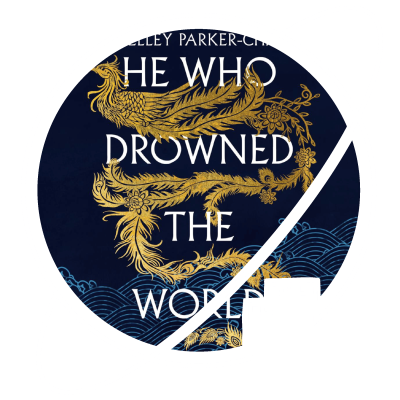

Listened to the audiobook with Natalie Naudus again – would definitely recommend the experience to make China actually sound Chinese.
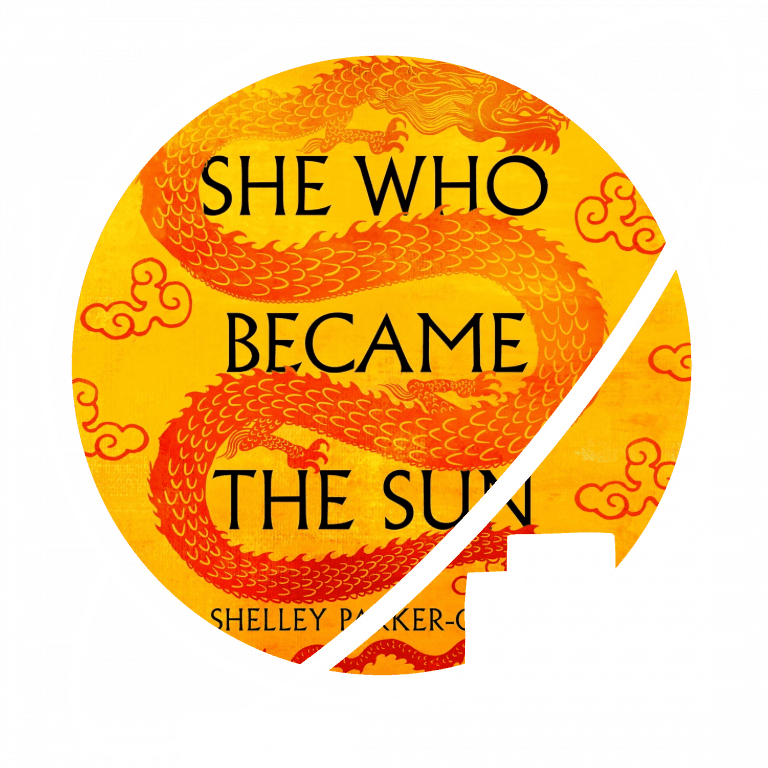
I was very enthousiastic about She Who Became the Sun, a book I randomly picked up because of the Hugo nomination. Ever since I’ve finished it, I have been recommending it left and right, in particular for its historically plausible inclusion of 21st-century themes in a book set in medieval China. I’ve had the sequel to She Who Became the Sun on my release radar ever since I finished the first book, and I loaded He Who Drowned the World into my player almost the moment it became available.
And it did not disappoint!
He Who Drowned the World is a lot darker than She Who Became the Sun, and by ‘a lot’ I mean a big lot. The first book has some negative themes, such as revenge and body dysphoria. And of course, Zhu will literally and figuratively kill to reach her fate. But Zhu is, on the whole, an optimist with a positive drive.
He Who Drowned the World, however…
The second book focusses on Wang Baoxiang, the new Prince of Henan – as a point of view character in addition to Zhu. And he is one of the most tormented characters I’ve ever read, with frightening self-loathing and purpose dripping off the pages . Reading his chapters filled me with equal measures of disgust, pity and awe. To think this is only Parker-Chan’s second book and already she has developed such finesse in making her character’s deepest, darkest thoughts feel true makes you almost dread what torment she will bring to her pages in the future.
I would compare the darkness of He Who Drowned the World to Joe Abercrombie’s writing, but Parker-Chan doesn’t mix in the black British humour that Abercrombie does, making the read a whole lot heavier.
The darkness Wang Baoxiang injects into the narrative fits well with the theme of this second book. A whole cast of characters, each with their own glowing mandate of heaven, is vying for the throne of the Great Khan. As they battle each other for the best position to take on the capital of Dadu, each in turn is confronted by the cost of their great desire. What are they willing to sacrifice to become Great Khan? What must they do to make it all worth it?
I think this is a great theme for a novel which really drives home the point that ‘no really, they are all the villain’. Each of the pretenders tears apart those around them and must leave something of themselves behind to reach that one goal. In a way, He Who Drowned the World fits the frame of a classic Shakespearian tragedy very well.
So Parker-Chan deserves the highest praise for her character writing. Does the rest of the book hold up?
Well, it’s probably not what you’re reading the series for, but it is not bad either. He Who Drowned the World has nothing of the classic comfort we all know from the first book in a fantasy series, but rather dives straight into the action, both at court and on the battlefield. Really though, all of the plot is strictly in service of the character arcs of the main characters; and while there are tense moments, they exist for the characters to doubt their conviction rather than for any real chance the plan will fall apart.
I would even go as far as to say that the book has a bit of a weak point in Zhu’s naval campaign, in which Zhu comes up with increasingly far fetched and unlikely clever tricks to beat an opponent that by rights should have defeated her easily. I realise it is Zhu’s trademark from She Who Became the Sun, but it really rubbed me the wrong way this time; it fits with the annoying Hollywood trope of medieval battles always being a mess without any sort of organisation, that end up being won through too-clever-by-half techniques that would not work in real life (think about it, if random balls of flaming whatever-it-is-Hollywood-special-effects-teams-love would have won battles in history, we would have sources telling us about them). I have always felt that it shows a lack of respect for the medieval mind to suppose that these people just failed to come up with these brilliant, battle-winning stratagems that writers behind their 21st century desks dream up.
That – very personal – rant aside, I really enjoyed He Who Drowned the World – I think I blasted through it in only four or five days (admittedly, I had a sowing project to get through). I think it’s grimdark tone means it may be less appealing to some than She Who Became the Sun. But I think the character writing is some of the best out there, and if you are not put off by a dark tale of mental, physical and sexual violence, He Who Drowned the World is a gripping read you won’t be able to put down.
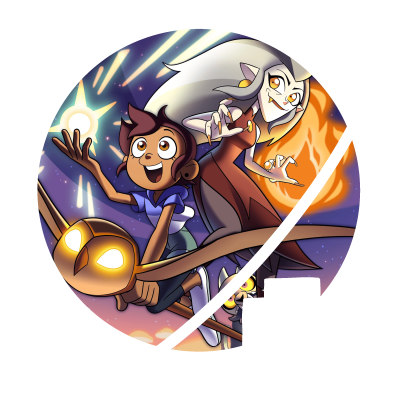

When Jasmijn and I started watching The Owl House – only a few weeks ago at the time of writing this review – I mostly expected an animation series with a typical “some plot and a lot of filler episodes”-structure, quirky humour and some likeable characters. What I got was a unique fantasy/horror comedy setting with deep lore, many character-driven subplots and an impeccable pacing. And then I haven’t even mentioned the strong cast of characters!
The Owl House has a compelling main plot with plenty of mysteries and a main antagonist that suits the central themes of the story: the importance and beauty of wholly being yourself and the legitimacy of found families. Each character explores these themes in different yet interesting ways. Sure, I have a specific fondness for these kinds of stories, but I think the quality of the writing and humour make The Owl House especially accessible. Additionally, the cast represents so many different identities! Best of all, unlike in real life, never are these identities a part of the characters’ issues. Sure, they have struggles, personal goals and difficult people they have to deal with. However, things like their sexual preference or gender identity are never controversial. This kind of representation is still rare in media nowadays, but a treat to behold. And remember, this is Disney production. The creators had to fight for every crumb of LGBTQ+ representation. To name a few examples of the diversity that are canon and actually visible… We have a Latina bisexual female protagonist. A cool mentor character that suffers from a magical interpretation of a chronic illness. An older non-binary character using they/them pronouns. Asexual characters, lesbian characters, characters that have two dads, genderqueer characters etc. It’s an universal story.
I would also like to very much praise the art and animation of this series. Though I wasn’t immediately sold on the aesthetics of the Boiling Isles setting, I quickly came to appreciate how it fits the worldbuilding and main themes. Also, there were multiple action/fighting scenes that really had me excited because of the smooth animation!
Unfortunately, many wonderful series get cancelled too quickly. Series that have important stories to tell and the right loveable yet complex characters to tell them with. The Owl House is definitely one of these series. Luckily, the creators still got the chance to end things in a satisfactory way.
I can honestly say this show will forever be one of my comfort go-to’s. #Lumity

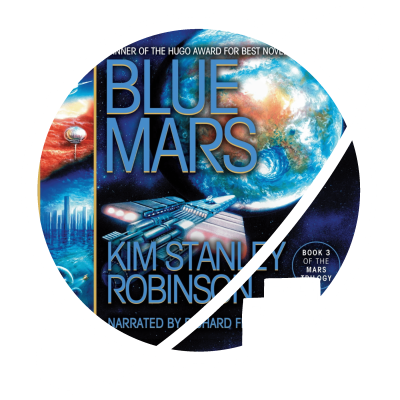
Listened to the audiobook with Richard Ferrone – narration fits with the book really well.
Blue Mars continues the evolution of the Mars-trilogy: from the intra-group politics of Red Mars, to the Martian politics of Green Mars, Blue Mars now brings us interplanetary politics involving not just the Earth and Mars, but the inhabitants of the rest of the solar system as well.
Interestingly, with the increasing scope of the narrative, it felt as if Robinson was able to let go of the need to describe every stage in the story. Instead, Blue Mars returns to more of a patchwork of separate stories that are actually much closer to some of the characters in the story. As a result, even though the book covers a lot more time and space than the previous works, it feels at least as character-driven as Red Mars.
Blue Mars is also a lot more diverse than either Red or Green. As Mars undergoes terraformation, its climate and biosphere grow more robust and varied – and so the action doesn’t just take place on red desert or white ice, but on biotopes nearly as diverse as those on Earth. In addition, without giving away more than necessary, Blue Mars takes some of our main characters off-planet on expeditions to places familiar and new. All in all, not a page of the book feels stale, or a rehash of what the trilogy has done before.
That being said, this is still the Mars-trilogy, with its trademark deep dives into areology (that is to say, the geology of Mars), sociology, politics and, in Blue Mars, even the biochemistry of memory and a little string theory (I am not making this up!). And if you’ve gotten to this point in the trilogy without giving up, I am sure you’ll enjoy those tangents too!
If you’ve read the first two books, you’ll know what to expect: a novel that puts the science in science fiction, while intimately close to a set of characters that are each struggling with their relationships to those around them, and with their role in the colonisation of Mars.
Above all else, Blue Mars is a very satisfying conclusion to an ambitious trilogy, and a cli-fi novel that wrests a hopeful ending from the jaws of realism – perhaps that final achievement alone makes it worthy of the 1997 Hugo!
Children of Time is one of those books that so many people recommended to me that at some point it just had to skip to the front of my shelf of shame, despite that fact that Tchaikovsky’s Dogs of War fell in the decidedly meh-category for me.
So the question is: why the hype, and did Children of Time live up to it?
I think the hype mostly comes from the fact that Children of Time is very original. It’s just new. It does things you can’t find elsewhere in science fiction.
Children of Time features an ambitious long-timelines evolutionary narrative that is not only very interesting in its worldbuilding, but somehow also manages to stay interesting on a plot level.
And then the novel combines that one narrative, that will take countless years to cook properly, and combines it with another narrative of humans in-and-out of cryosleep on a colony ship – which skips through the same amount of time featuring a single, continuous set of characters.
The setup takes a couple of sci-fi handwaves to work, but I’m all aboard with that for such a clever idea. This story structure addresses some of the typical issues with stories with far horizons (Asimov’s Foundation comes to mind) in that the human characters, with whom the reader is supposed to bond and who are ultimately what draw the reader into the story, necessarily can’t survive long enough to make it into the next chapter.
Tchaikovsky’s clever structure alone is probably enough to make this book worth reading. But the hype does not lie – both halves of the narrative are also independently good.
The spider half of the story (wait, what? Yes, a spider-half of the story), focusing on biological and cultural evolution, moves at breakneck speed and may strain your suspense of disbelief at times, but it is always interesting and surprisingly suspenseful given the shifting main characters.
The human half of the story initially appears more traditional, but as the narrative progresses and the insanity of living in short bursts over the centuries on a cramped space ship ramps up, it takes a turn for the surreal and ended up reminding me of the post-apocalyptic psychedelic ride that is Metro 2033.
If that doesn’t pique your interest, then I don’t know what will.
Is there anything negative to say about Children of Time? I think it would be that Tchaikovsky’s style is to focus on the interesting ideas more than on how they work – I saw Lotte mentioned Children of Time fitting the ‘hard sci-fi’ category and I have to give that a hard disagree – its not as soft as some space opera, but artificial gravity fields? Human consciousness uploads? Rapid evolution virus that recognises other bearers of the virus? Stuff like that is borderline magic, and while I don’t have a problem with it per se, Tchaikovsky leans on it a lot. But as long as you don’t go into it with the wrong expectation, that should not keep you from enjoying Children of Time.
One final thought – which some may consider a spoiler and some may not, so read at your own peril – is that Children of Time shares a very negative perception of humanity with Dogs of War, with both novels eventually settling on the conclusion that humanity needs to be ‘redeemed’ or ‘improved’ by some outside factor. I don’t mind a bit of moralising, but the ending of both novels was frustrating to me because Tchaikovsky is telling us we’re not good enough, but in neither case his suggested improvement is something that we have. I guess I’ll just have to take it metaphorically.
I got this book as a present from my dad. Whenever I get gifted a book, I try not to look at the summary on the back and just go in blind. That’s what I did with Children of Time.
All I knew going in was that it was a Sci-Fi story about evolution. And it was! Children of Time is unlike most novels precisely because of this focus on evolution. While we do follow a couple of specific characters from the start to the end of the book, this is only the case for one half of the cast: the humans. The other half of the cast are spiders.
It feels a bit like a spoiler to say that in a review, but I feel that it’s extremely relevant because of two reasons. One: if you hate spiders, as many people do, this book may not be for you. However, the second reason is that Children of Time is a fascinating exploration of what a society of spiders may look like, had they evolved in a similar way to humans.
I’m not a huge fan of spiders myself. I like the idea of them, but I like to keep some distance between us, generally. However, I really enjoyed the spider chapters in Children of Time. They offer some extremely fun world-building and surprisingly believable characters.
I wasn’t as much of a fan of the characters on the human side, but the writing was solid and both sides of the story made sense, in a way. I think it would be easy in a story like this to paint one side as the “bad guys” which doesn’t really happen here.
One thing I wasn’t counting on but I feel I should warn readers for is the fact that this is part of a series. It’s definitely readable as a stand-alone, and the ending is satisfying enough for me (though I can also imagine people disagreeing very strongly on this). Still, around halfway through I started to feel like I was reading a prequel for another story. It’s very much a story of “how we ended up in this situation”. I was expecting the ship to land at some point, and for there to be genuine conflict between the spiders and the humans, but that’s not really what this book is about. Children of Time focuses mostly on the evolution of the spiders, and the struggles of humanity trying to survive in a time where Earth is no longer inhabitable.
While I really did enjoy this book, I didn’t find myself running to the store to buy the sequel. Most of the story is neatly tied up at the end of the book, albeit very hastily. I’m still unsure whether I think that’s a good thing or a bad thing.
Overall I would definitely recommend Children of Time! Especially if you like Hard Science Fiction, good world-building and, of course, spiders.

Tonke Dragt may have written my favourite Dutch children’s book of all time, but when I was younger, Thea Beckman was my favourite author. She is best known for her amazing children’s historical fiction, ranging in setting from the crusades all the way to the renaissance.
Fascinatingly, she also penned the Children of Mother Earth Trilogy of post-apocalyptic science fiction novels, which may actually be some of her best works. I am honestly distraught that they apparently haven’t been translated into English – I just assumed they would be available but apparently they’ve only been translated into German and Hungarian. So our apologies to English-speaking readers!
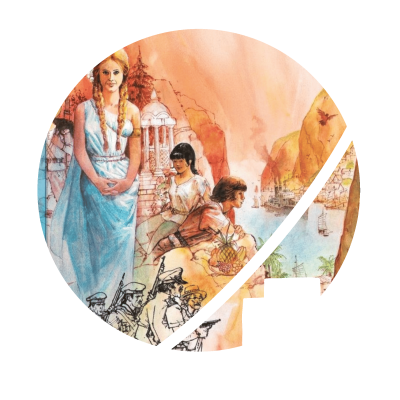
Children of Mother Earth is the first novel in the trilogy, and spends a lot of time describing the society of Thule. In doing so, Beckman paints a utopian picture of an alternative way to run a society, clearly intended for readers to start questioning the cultures that they themselves live in.
Though originally written in 1985, I feel the message in Children of Mother Earth is no less relevant and no less important nearly 40 years later. Even though Beckman’s apocalypse was cause by nuclear war instead of climate change, Children of Mother Earth is way ahead of its time in many ways – it feels like Beckman wrote a cli-fi novel and a solarpunk utopia, both avant la lettre.
One element in particular that was a relevant in 1985 as it is today is Beckman’s foray into the role of gender in society. In particular, Children of Mother Earth is great at challenging masculinity and femininity, and provides role models for both male and female characters with more masculine and more feminine traits.
Finally, Children of Mother Earth does a great job of describing the difficulties of intercultural communication. The reader is constantly identifying with both the protagonists and the antagonists, bouncing back and forth between them as they try to understand each other’s customs.
And alongside all of these great educational qualities, Children of Mother Earth is also just a great novel, with lovable characters, set in a heart-achingly beautiful country, with moments of great tension as well as interpersonal drama, constantly thought-provoking but never tedious. Even if you’ve never given these books a shot as a child, I found Children of Mother Earth highly enjoyable as an adult. And if you have children in their early teens…