






Listened to the audiobook with Ben Allen. Very well read.
Before you read the rest of my review – I just read it back and I realise it comes of very negative. Please don’t walk away from this thinking reading Alien Clay is a waste of time – I did enjoy reading it and I would recommend it – it is not particularly long, well paced and it has some fascinating alien biology that really sets it apart.
However, I think my review below very clearly shows that that I felt a little disappointed with the potential that I think Tchaikovsky ‘wasted’ when he used his biological knowledge and premise on a quick novel that is just lacking a little in depth beyond it.
I couldn’t shake the impression though that Alien Clay was a bit rushed, particularly in the worldbuilding and the resolution. That might just be a style thing – I don’t think that Tchaikovsky would have wanted to elaborate on the background of his story. But I felt like Alien Clay was brimming with interesting ideas that were stretched over a really thin plot and supported with bare bones worldbuilding.
First, the plot of Alien Clay is really about as simple as it gets, not bad but hardly worth discussing. More interesting is the worldbuilding.
When I say that Alien Clay has ‘bare bones worldbuilding’, I am not necessarily referring to the biology of Kiln, the planet that is effectively the main character of this book. I think the premise – evolution not through competition but symbiosis – is great. I love that the biology Tchaikovsky presents actually feels alien, which is a feat surprisingly few science fiction writers manage.
What is missing though, is the background on the human landscape. Tchaikovsky does some cursory work on the repressive and scientifically regressive regime on earth, but I think the novel would have benefited from more details on the characters’ lives back home. I liked his description of the between-fear-and-hope atmosphere in the scientific community in earth and I think it was worth spending some time on. I also felt like our main character didn’t actually live a life on his home planet.
Moreover, there is an episode halfway through the novel that Tchaikovsky seems to have just given up on – he skipped forward, gave a couple of anecdotes from that time in between, and moved straight to the final face off.
While I agree that the novel would not have necessarily improved from describing that one particular event in detail from start to finish, I feel like the way Tchaikovsky choose to work around it was representative of the issues that I have with Alien Clay. I feel those might have been ironed out with the input of a good editor.
Finally, the ending of the novel was a little predictable – in particular when viewed in line with Tchaikovsky’s other work (’humans need something inhuman to improve upon themselves’). It wasn’t helped, of course, by the lack of depth in the characters themselves or the de-individualisation that he puts them through. I think it underlines that Tchaikovsky simply wasn’t interesting in writing a particularly engaging plot or characters.
In the end, I switched off Alien Clay when it finished, wondering whether it would not have been better off as a novella.
In short: great ideas, great execution in one aspect, just a little lacklustre in others – still worth reading.

Listened to the audiobook with Ben Elliot. Well narrated.
I think I started Half a War the same day that I finished Half the World. I blasted through the entire trilogy in just over two weeks of listening. Perhaps that is all the review you need. If you want to learn a little more… read on.
Half a War surprisingly feels more like a sequel to Half a King than to Half the World.
The plot of Half a War has a bigger scope than the previous instalments, focussing on war and politics and not following the somewhat predictable Hero’s Journey that I noticed in the first two novels.
Like Half the World before it, Half a War introduces a new cast of characters and folds them into the ongoing narrative with the characters the reader already knows. In the case of Half a War, though the build up of characters throughout the trilogy means that there is not enough space in the novel for each of them to take their moment in the limelight.
An unfortunate victim of this is Thorn Batu, the protagonist of Half the World. One character that does shift back into focus, however, is Father Yarvi, our protagonist from Half a King.
There are a couple of scenes early in Half a King that gave me premonition of where Yarvi’s character might be headed, and I am glad that Abercrombie zooms back in on him for this final book in the trilogy, even if it is still through the eyes of other characters.
Despite the bigger scope and the amount of characters, there just about enough room for the main character’s development. Skara’s line is the strongest in the book and the one that makes it worth reading. I will not say that it is full of surprises, especially if you have read a little of Abercrombie’s work before – but it is satisfying enough to wrap the trilogy nicely.
If there is one aspect of this trilogy I would have liked to see Abercrombie do differently, it is the post-apocalyptic elements.
Sure, they do play a bigger role in Half a War than in the previous instalments, but in the end, the pre-apocalyptic technology basically takes the place of magic and provides an unearned resolution to the main characters’ central challenge. There is no significance to the fact that the world is our world. Having read the whole trilogy, I cannot help but feel that Abercrombie could have saved that idea for a story that put a little more emphasis on it.
So what is my final verdict on the trilogy? I enjoyed all three books. They were quick and easy reads, not burdened by too much build up or worldbuilding. The Shattered Sea Trilogy are unpretentious adventure fantasy novels that are far enough off the beaten track to not be forgettable. You would not be remiss giving them a shot if you are looking for something a little simpler, but still expertly crafted. On the other hand, the Shattered Sea Trilogy does not have the depth – either in character, worldbuilding or plot – to truly captivate a regular reader of fantasy.
One thing I will take away from reading this trilogy – other than the hours of entertainment the novels gave me – is that the perfect balance between pacing and depth that I like is difficult to find. Looking just at Abercrombie, I think the First Law Trilogy has great depth, but is very slow out of the gate. The Shattered Sea Trilogy is very well-paced with not a slow page in it, but lacks somewhat in those extra layers that will truly immerse a reader. I think Abercrombie strikes the best balance in Best Served Cold and The Heroes, though there is some cheating there since the First Law Trilogy has already done a lot of set up for the world they take place in. Food for thought.




I watched Love and Monsters over the span of two days, and I enjoyed it! It definitely didn’t blow me away, but I appreciated that we got to actually see the monsters that we were promised in the title. They were good monsters, too.
Love and Monsters is a movie you can easily put on in the background, but it definitely has enough character to keep you invested while you watch. I’m easily distracted, so if I’m multitasking, whatever I’m watching has to be interesting enough to watch with one eye, but it definitely shouldn’t require me to be thinking along as I’m watching. Love and Monsters was exactly that. It is still the kind of movie you could enjoy while paying full attention to it, that’s just not my style of media-consumption.
While I’m very tired of post-apocalyptic stories, the premise of Love and Monsters is so far removed from any of the actual problems we are facing as a planet, that I happily stomached it. In a way, it felt much more like the type of post-apocalyptic story that would have been told before we got so much new material to work with!

Listened to the audiobook with Ben Elliot. Well narrated.
Because Half a King was such easy listening, I rolled straight into its sequal Half the World after, half expecting the story to focus on Yarvi and politics at the courts of Thorlby and Skekenhouse.
Instead, Half the World introduces a whole new set of characters and launches into a whole new story that is connected to Half a King but is really not a continuation of the same story, other than featuring some of the same characters.
In how it treated these characters, it reminded me of Earthsea, which also shifts the main characters of each previous book into the background for the next instalment in the series.
Half the World is a travel story, taking a crew through an arduous journey to a distant destination and back again, seeing places, meeting kings and emperors, making new friends and enemies and meeting old friends and enemies along the way.
It focuses on the character of a girl who wants to be a warrior. And while I did enjoy reading about her, the story is not particularly original. I think the book’s main let-down is that she doesn’t appear to develop much as a character. It is another indication that these are story-driven adventure books, with interesting but not necessarily deep characters and not a lot of drive to innovate.
One element of the book that could perhaps have been innovative is the post-apocalyptic aspect of the world, which is pretty much confirmed in Half the World. But it doesn’t really appear as if Abercrombie is interested in developing that aspect of the world. As a result, it can feel a little like an immersion breaker – ‘oh right, he had this post-apocalypse going on, I wonder what he is going to do with that’. I wonder whether it will play more of a role in Half a War.
Interestingly, when I thought Half the World had more or less ended and completed the hero’s journey cycle (which, again, was a little obvious), there was about a quarter of the book left to go. This added quarter at the end of the book has a couple of awkward moments that I feel might have better been carried over to a sequel. On the other hand, these scenes nicely set the stage for Half a War and also give the book a little unpredictable twist that is not unwelcome for the series.
Overall, I think the adventure and story in Half the World was enjoyable and I think the journey from the pseudo-Baltic down the pseudo-Dnieper to pseudo-Byzantium was a great setting.
I’m already a good way into Half a War, which I think tells you all you need to know!



I shall admit my expectations for this movie weren’t very high beforehand. A story based on the game The Werewolves of Millers Hollow? Maybe I’m biased by my previous experiences with adaptations of video games and board games, but I couldn’t see much appeal. However, I was in the mood for something less challenging (I had just finished my rewatch of Black Sails, which is not fantasy but certainly a recommendation) and I like werewolves, so… why not?
Against my expectations, my effort was rewarded with a story filled with underutilized potential. This might not sound as much, but I was pleasantly surprised. There are some good ideas in Family Pack, specifically the different ‘roles’ from within the game and how they could be applied in a more realistic setting, as well as the family dynamics (I was actually touched by the little character arc of the grandfather, for example). With a little more polishing, or different directing goals, the story could have easily been more memorable.
However, as it stands now, Family Pack is mostly a decent, fast-paced movie for the whole family, with what I would call ‘typically French humour’ (my main point of reference for this being the Asterix & Obelix live action movies, so take it with a pinch of salt). A fine way to fill up a lazy evening, but unlikely to make a lasting impact on your life.



Listened to the audiobook with Ben Elliot. Well narrated.
I loved Joe Abercrombie’s style of prose in the First Law-world. I think that the First Law-trilogy itself was good, but not amazing. The individual characters were great – Logen Ninefingers and Inquisitor Glokta are memorable and gruesome and creepily easy to empathise with. But the overarching story took a long while to get going and was perhaps just a little vanilla. Abercrombie first really hooked me with the three ‘standalone’ novels in the First Law-world that came after the trilogy, that focussed more on some of those great characters.
So when I picked up Half a King, I was very curious where the Shattered Sea-trilogy fit on the spectrum.
The first thing to note is that the books are significantly shorter than the First Law-books, and it shows in the pacing. The adventure starts pretty swiftly and keeps moving at high speed until the book’s conclusion.
Because of the amount of story crammed into the relatively short novel (for a fantasy book) due to the high pace, there is not as much attention to worldbuilding or even to character as I might have liked. I liked the grounded, low fantasy setting (with some …potential post apocalyptic vibes?), but it remains in the background throughout.
The result is that Half a King was an enjoyable enough read, but also lacked the depth to really get me invested. I also found that the prose was missing some of the dry humour and flourishes that made me appreciate it so much in the other Abercrombie works I have read.
It is notable that the book sticks very close to the classic Hero’s Journey. It was not jarringly obvious, but more seasoned readers of fantasy might find the patterns a little predictable.
I have seen the Shattered Sea-books labelled Young Adult. I can see that they are more suited to younger Fantasy readers than Abercrombie’s other works. I get that they are significantly less grim and a simpler in story than the First Law-books.
However, Half a King is by no means the romcom with a fantasy veneer that YA Fantasy has a reputation for. It is a simple, broadly enjoyable fantasy story with just enough going on to help me race to the end in a handful of days.
I will continue with the trilogy and report back to you – perhaps some of that mysterious post-apocalyptic-looking stuff will play up in the next books, and it will turn out that the story doesn’t just take place in the pseudo-Baltic but the actual Baltic in some distant future. We will see!
Review: Rogue Protocol – Martha Wells
Part 3 in the Murderbot Diaries – Following the revelations of Artificial Condition, our Murderbot travels to a far-flung orbital mining facility to further investigate the crimes of its former owners. It infiltrates an expedition sent there to assess the condition of the facility before a full salvage operation will commence, by making friends with a robot who has a relationship with their owner unlike any the Murderbot has encountered before.
Review: The Boy and the Heron – Hayao Miyazaki
A boy called Mahito and his father move to the countryside while the Pacific war rages in Japan. Mahito’s mother has died in a hospital fire during the war, and his father is marrying his late wife’s sister, Natsuko. Mahito struggles to find his place in the peaceful countryside until a mysterious heron leads him to explore a mysterious tower.
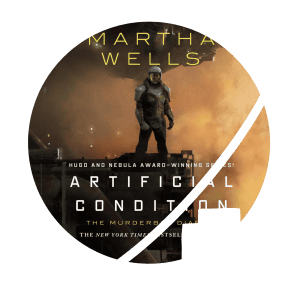
Review: Artificial Condition – Martha Wells
Part 2 in the Murderbot Diaries – Following immediately after the end of All Systems Red, Artificial Condition follows our GenZ Murderbot as they stowaway on an interstellar transport to a far-flung mining station in an attempt to figure out more about the incident in which they went rogue, which caused them to hack their governor module and become a free agent in the first place.
Curator Question: 2024 Resolutions
Our Curators discuss their 2024 New Year’s Resolutions – what is on their to be read/watch/listen/play list for the coming year?
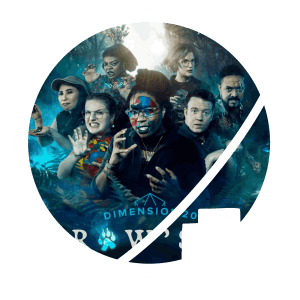
Review: Burrow’s End – Dimension 20
Burrow’s End follows a small family of stoats who are driven out of their burrow by a mysterious storm. As they fight to find a new home, they soon realise that the real world is threatening in ways they could never have imagined. The season is DM’ed by Aabria Iyengar, and stars Brennan Lee Mulligan as single mom Tula, with her children Jaysohn, a hyperactive karate kid (played by Siobhan Thompson), and Lila, a clever know-it-all (played by Isabella Roland). Tula’s sister Viola (played by Rashawn Scott) is the enigmatic wife of cult leader Thorn (played by Jasper William Cartwright). Tula and Viola’s mother is a grizzled old stoat named Ava (played by Erika Ishii).
Yearly Wrap-up: 2023 in Review
Our curators look back at their 2023 resolutions, and their favourite fantasy and science fiction media of the past year. Which media on their to be read/watch/listen/play piles got their attention? And what else did the year bring?